Originally published 11/20/26.
Click here to go straight to the best stand mixers list
When I was growing up, every kitchen appliance my parents had seemed to last forever. From the time I was born until I was an adult, I remember my mom and dad owning just one hand mixer, one toaster oven, one juicer, one drill, one phone, one TV, one stereo, one iron… the list goes on and on.
Fast forward to today. I can’t go two or three years without a kitchen appliance breaking on me. We’ve gone from disposable cups and plates to tossing our toasters and air fryers into the trash. We don’t even need to clean our appliances anymore. When one gets too dirty, we just toss it and get a brand new one from China. Where does all that plastic and metal and glass end up? Not our problem. Someone will figure it out, right?
And no, paying more doesn’t help. I paid top dollar for a Breville toaster, and it doesn’t toast evenly anymore. We also paid top dollar for a Breville Barista espresso machine, and it’s been hit or miss lately.
The one appliance in my kitchen that has stood the test of time is my KitchenAid mixer. It was one of my first purchases when I started working almost 30 years ago, and it’s still going strong, just as good as the day I got it. I’ve used it for everything from kneading dough and making homemade pasta to grating cheese, shaving ice and making ice cream. I’m sure it’ll keep going for years to come. What other appliance can you say that about anymore?
Where did the stand mixer come from?
The stand mixer is an American invention, and an Ohio one at that. Herbert Johnston, an engineer at the Hobart Manufacturing Company in Troy, Ohio, came up with the idea after watching a baker mix bread dough by hand. Hobart’s commercial mixer was such a hit that by 1917 the U.S. Navy had made it standard equipment on all of its ships.
In 1919, Hobart brought a smaller version into home kitchens under a new name: KitchenAid. The story goes that one of the first people to test it said “I don’t care what you call it, it’s the best kitchen aid I’ve ever had.” (The Smithsonian’s curator admits nobody can verify that one, but it’s a good story.) It wasn’t cheap. The 1922 H-5 model sold for $189.50, which is more than $2,800 in today’s money.
In the 1930s, industrial designer Egmont Arens drew up the Model K, and that’s the shape you still see on kitchen counters today. In 1997 the San Francisco Museum of Modern Art named it an icon of American design.
The KitchenAid stand mixer is still made in Ohio
KitchenAid has built its stand mixers in Greenville, Ohio since the 1940s. Whirlpool bought the brand in 1986, and it kept them there. Every KitchenAid stand mixer sold anywhere in the world is still assembled in that one plant. By 2018 the factory was turning out nearly 3 million of them a year, and the plant and its distribution center employed about 1,200 people.
That doesn’t mean everything with a KitchenAid logo is safe. KitchenAid sent its hand mixers to China and only brought them back to Greenville around 2012 (Whirlpool said so in its own press release), and I’ve documented the confusion that followed in my post on hand mixers. But the stand mixer is the crown jewel of the brand, and so far Whirlpool has had the good sense not to touch it.
How the rest of the category was lost to China
KitchenAid’s biggest American rival was the Sunbeam Mixmaster. Sunbeam was a Chicago company, and its Mixmaster, introduced in 1930 and designed by a Swedish immigrant named Ivar Jepson, was its flagship product for about forty years. In 1981 the new owners closed most of Sunbeam’s Chicago-area factories. Then came the Al Dunlap accounting scandal, a bankruptcy in 2001, and a string of sales. Today the Sunbeam name belongs to Newell Brands.
Across the Atlantic, the British had their own icon, the Kenwood Chef. It debuted at the Ideal Home Exhibition in 1950 and became a fixture in British kitchens. Italy’s De’Longhi bought Kenwood in 2001. Kenwood’s own website now says that all Kenwood Chefs are designed in the UK but “are now made in China at our Delonghi Group factories.”
Most of the other names you’ll see in a department store tell the same story, they just don’t say it out loud. Crate & Barrel lists its KitchenAid Artisan as “Made in USA of Imported Materials.” Its listing for the Cuisinart Precision Master says one word: “Imported.” As I’ve written in my post on retailers and country of origin, when a retailer won’t name the country, there’s usually a reason.
And then there’s Amazon. Search for “stand mixer” and the first page is full of brands like Aucma, Kitchen in the box, Honinst and Hauswirt. Aucma’s mixer alone has more than 15,000 ratings. Aucma is an appliance company out of Qingdao, China. These mixers advertise 660-watt motors and 6.5-quart bowls at a fraction of KitchenAid’s price, but the wattage on the box only tells you how much power the motor draws, not how much makes it to your dough. KitchenAid’s Artisan is rated at 325 watts and has been kneading bread dough for generations. (If you want to learn to spot these brands, I’ve got a whole post on how to tell if a product is made in China on Amazon.)
Are any stand mixers not made in China?
Yes, and this is one of the few kitchen appliance categories where you have real choices. Besides KitchenAid, there are three European makers that still build their mixers at home: one in Sweden, one in Slovenia, and one in Italy. Each of them takes a different approach to mixing, so which one is right for you depends a lot on what you bake.
Best Stand Mixers Not Made in China
1. KitchenAid Artisan 5-Quart Tilt-Head Stand Mixer – Best Overall

There’s a reason this is the mixer you picture when someone says “stand mixer.” The Artisan has more than 30,000 ratings on Amazon with an average of 4.7 stars, and its basic design hasn’t changed much since the 1930s. That’s a good thing: parts are easy to find, and the attachment hub on the front runs everything from pasta rollers to meat grinders.
Crate & Barrel lists the Artisan as “Made in USA of Imported Materials,” which is the honest way to say it. It’s assembled in Greenville, Ohio, but like nearly every appliance today, some of the parts come from overseas.
If the Artisan isn’t the right size, the rest of the stand mixer line comes out of the same Greenville plant:
- Classic Series 4.5-Quart: the no-frills version, with more than 12,000 ratings of its own.
- Artisan Mini 3.5-Quart: about 20% smaller and lighter, for small kitchens and smaller batches.
- 5.5-Quart Bowl-Lift and 7-Quart Bowl-Lift: the bowl raises up to the beater instead of the head tilting down, which holds up better to big batches of stiff dough.
2. Ankarsrum Original Stand Mixer – Best for Bread

If you’ve never seen one of these, it looks like it came from another planet. That’s because it works completely differently from a KitchenAid. Instead of a beater that spins around inside a still bowl, the Ankarsrum spins the bowl itself, driven by a motor underneath, while a roller and scraper stay in place. The result is a lot of torque, very little noise, and a mixer that doesn’t walk across the counter when you’re kneading a heavy dough.
The design goes back to 1940, when Electrolux introduced it in Sweden as the Assistent. Since 1969 it has been made in the town of Ankarsrum, and today Ankarsrum says each one is made by hand in its facility there. The US model has a 600-watt motor, a 7.3-quart bowl that can handle up to 11 pounds of dough, and a 7-year warranty, which is about as good as it gets for a kitchen appliance.
Ankarsrum has a cult following among bread bakers (the brand gets more than 20,000 searches a month on Google), and once you understand how it works you’ll see why. The learning curve is real, though, since none of your KitchenAid habits carry over. I’ve linked to Abt here because the Ankarsrum has been hard to find in stock on Amazon.
3. Bosch Universal Plus Stand Mixer – Best for Big Batches

Bosch is a German brand, and its stand mixer is still made in Europe. Both NutriMill, Bosch’s US distributor, and its authorized Canadian distributor list the Universal Plus as made in Slovenia, where Bosch runs its main European factory for small kitchen appliances.
Like the Ankarsrum, the Bosch drives from below, with the dough hook coming up through the middle of the bowl. It has a 500-watt motor and a 6.5-quart bowl that Bosch says can knead up to 14 pounds of dough at a time. That’s why you’ll see it recommended so often by people who bake bread for big families. It’s also light compared to a KitchenAid, and it has suction cup feet to keep it in place.
It has close to 500 ratings on Amazon with an average of 4.6 stars, and it costs less than either the Ankarsrum or the bigger KitchenAids.
4. Famag Grilletta Spiral Mixer – Best for Pizza and Artisan Bread
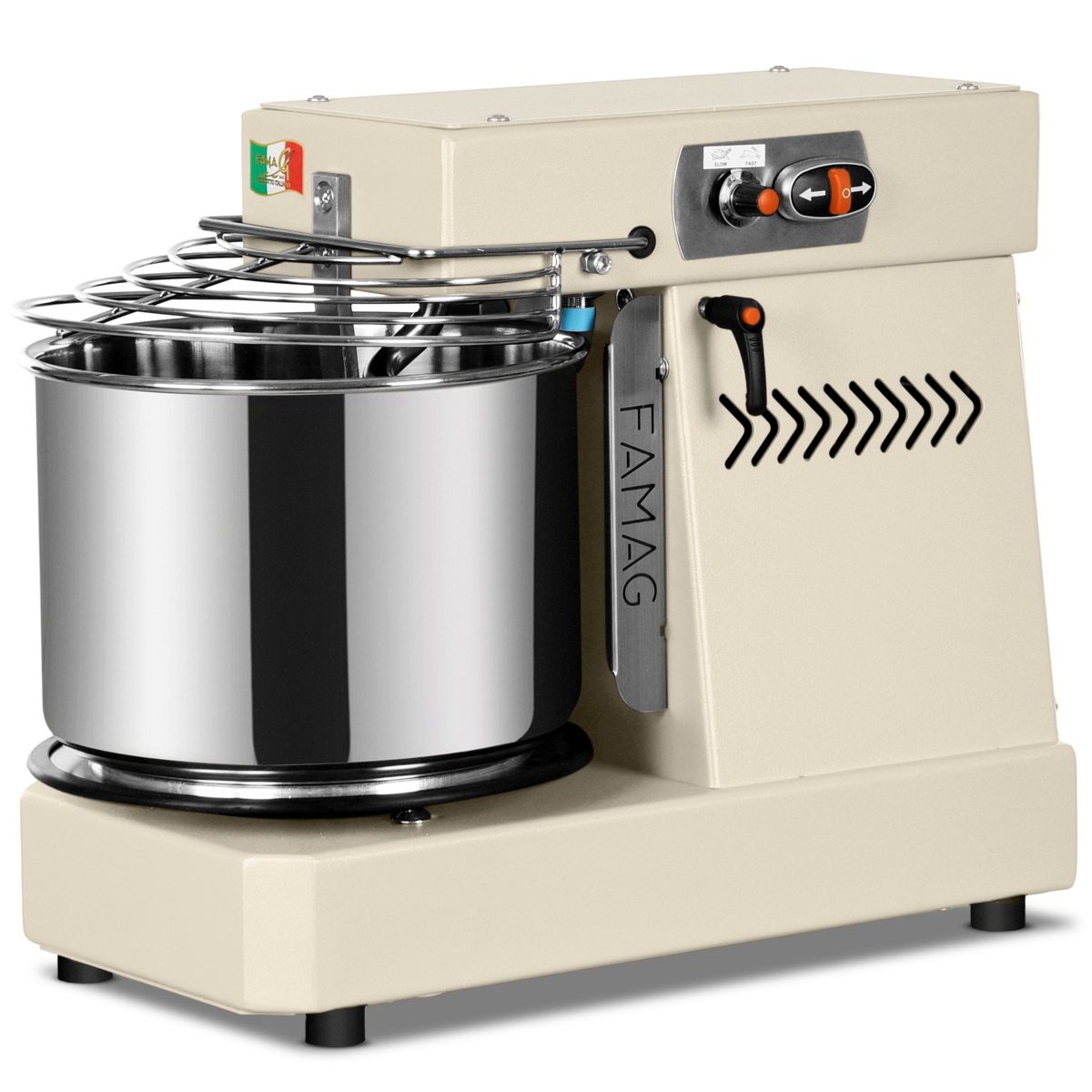
This one is for the serious bakers. A spiral mixer is what you’ll find in most pizzerias and bakeries: the bowl turns while a fixed, corkscrew-shaped hook works the dough, which develops gluten without overheating it. Famag is an Italian company that makes them, and the Grilletta is its smallest model, sized for a home kitchen and wired for a standard US outlet.
It’s made in Italy, handles anywhere from about 2 to 11 pounds of dough, and has an infinitely variable speed. If you make high-hydration pizza or bread dough, look at the IM-5S version, which has a tilting head and a removable bowl that’s much easier to clean.
It does one thing. You won’t be whipping cream or making cookies in it, and it costs more than anything else on this list. But if dough is what you make, nothing else here does it better.
Conclusion
The stand mixer is one of the rare categories where the original, iconic product is still made in the country where it was invented. If you’re shopping for one, there’s no reason to settle for a mixer from a brand you’ve never heard of, and if you need a hand mixer too, check out my list of the best hand mixers not made in China.
Do you know of other stand mixers not made in China? Let us know in the comments!