Last updated 11/23/26, 2/10/26, 8/24/25 and 11/20/23. Originally published 8/2/21.
The state of the cookware industry
Cookware is one of those commodities that you used to buy once and use for life. But nowadays, I find myself buying an entire new set once every five years or so. It’s not uncommon for pots and pans to split apart at the seams, develop rust and stains, and warp. And don’t get me started on non-stick surfaces.
But of course, every pot and pan set has stellar reviews on Amazon. Why? Because the cookware company just needs to impress people for the first few weeks. After a year (conveniently when the warranty runs out in most cases), that’s when things start falling apart. And as consumers, we’ve just gotten used to it. Unlike our grandparents and great-grandparents who lived through the Depression, subsequent generations have become accustomed to using things and dumping them in landfills so they can go on to (literally) the next shiny object.
I was pleased, though, to find a handful of brands who still “get it”. These include iconic brands like All-Clad and Le Creuset.
The cookware industry is an excellent microcosm to understand how entire categories of American manufacturing have been lost to China. Typically, you have a market leader who invented the category or brought the most innovation to the category (think All-Clad). In some cases, these brands brought life to entire communities and cities across the United States.
Once the 1990s and 2000s hit, things changed. Brands that were subpar or which were owned by big corporate behemoths (think Cuisinart) couldn’t compete on quality, but by offshoring manufacturing they realized that consumers would trade off perceived quality for price. So they sent all their designs, their manufacturing knowledge, and their intellectual property to China. And sure enough, that started to level the playing field. “Why should I pay $200 for an All-Clad pan, when I can get a Cuisinart for $100”. That started a race to the bottom that no American company can win, because eventually people will say, “Why should I pay $100 for a Cuisinart when I can buy a COLIBYOU for $50?”


How did you choose the best?
To identify the best of the best cookware not made in China, I scoured dozens of review sites and looked for cookware sets that seemed to come up over and over again on “best of” lists.
The first thing to do was to knock out all the brands that clearly sent most of their production over to China. That list includes Cuisinart, Rachael Ray, Greenlife, Greenpan (except its Italian-made Stanley Tucci line, below), Ninja, Bialetti, HexClad, Kenmore, Gotham Steel, most Zwilling lines (Vitale and Demeyere are the exceptions, below), T-Fal, Blue Diamond, and of course, Amazon Basics. Calphalon sadly looks like it’s on its way to moving all production overseas judging from the increasing number of people reporting “Made in China” on pieces that once were made in the USA. Anolon was hit-or-miss–their manufacturing was distributed between Thailand and China, but it’s tough to identify specifically for any particular product (this is where Country of Origin labeling would be nice). And of course, I had to get past the fake China brands like COLIBYOU, HITECLIFE, GRANITE STONE, KUTIME, and so many more.
That left a handful of brands. But what was left was usually the best of the best, at least in categories where manufacturing had at one point been done outside of China (sadly, for newer technologies like non-stick, American companies did the R&D but by offshoring manufacturing basically funded China’s rise to dominance–and their co-opting of their own intellectual property).
For now, I’ll keep one post dedicated to identifying the best of the best across multiple types of cookware. Scroll down to find what the best brand for your preferred type of pots and pans is.
Best Cookware Not Made in China
1. All-Clad D3 Stainless Cookware Set – Best Stainless Steel

All-Clad is perennially listed on the “best of” cookware lists, including being named as the “gold standard” by Food Network, “best splurge” by AllRecipes, and best “upgrade pick” by Wirecutter. New York Magazine named various pieces as the top choice of professional chefs.
All-Clad was founded in 1971 in Canonsburg Pennsylvania, toward the end of the era when America was the manufacturing powerhouse of the world and nearby Pittsburgh was the undisputed steel capital of the world. It was founded by John Ulam, who’d originally started the business to sell bonded metals (including metal used for coinage for the US Mint). Ulam made a pan for his personal use. The name “All Clad” refers to the process that they use to sandwich layers of metal together in a way that results in (literally) a fully-bonded and seamless pot or pan.
The cooking surface uses Type 304 stainless steel that is certified to meet ISO 9000 and ASTM A240 standards for food use.
If you’re confused at all the dizzying options for cookware, the one thing you need to be aware of is that stainless steel is by far the best material to cook with. Stainless steel is generally not reactive with foods, meaning there’s no danger of unpleasant or even dangerous chemicals leaching into your food, as may happen with cookware with glazed enamel or non-stick surfaces. Stainless steel distributes heat evenly, helping make sure your food is cooked to perfection. And it’s virtually indestructible, which explains why so many of them come with lifetime warranties. That’s why almost every professional chef you’ll talk to has a set that he or she uses religiously.
The one gripe people have about stainless steel is that food sticks to it, but that’s generally because they don’t heat the pot or pan sufficiently before they cook on it. But even if food does stick to it, a little Bar Keeper’s Friend takes care of it easily.
All-Clad, of course, makes many different types of cookware, but I’m focused mainly on their bonded stainless steel pots and pans (all of which are made in the USA, with some globally sourced components). You’ll find that it comes in two types: D3 and D5. This simply refers to the number of layers of bonded metal it has. D3 has steel + aluminum + steel, while D5 has steel + aluminum + steel + aluminum + steel. What’s the difference? In a nutshell, D3 heats more rapidly, while D5 heats more evenly. D5 is also more expensive. All of their stainless steel stuff still comes out of Pennsylvania.
I’ve tried using their Hard Anodized Nonstick cookware, hoping that the kind of engineering that went into their stainless steel pans also helped them make a better non-stick pan. The reality is that I’ve owned a few sets, and each time they only last a few years before the non-stick starts chipping off the surface and into my food. Not surprisingly, all of their non-stick stuff is made in China.
I’ve chosen their D3 Stainless Steel 10-piece set as the very best. It’s the set that most sites have put on their “best of” lists for having a balance of durability, ease of holding, and even heating. And unlike other cookware (or their own non-stick cookware), these are the kinds of pots and pans that you can use for a lifetime, and even pass down generations. Of course if you’ve got the $$, you’ll want to splurge for the D5.
2. Tramontina Signature 12-Piece Tri-Ply Clad Cookware Set – Stainless Steel runner up

Tramontina is a Brazilian company. It’s also listed on multiple “best of” lists, including Wirecutter and America’s Test Kitchen. As with All-Clad, their pots and pans are impact-bonded with three layers (Steel, Aluminum, Steel). It’s much more affordable than All-Clad: this 12-piece set is more than half the price of the comparable 10-piece set from All-Clad.
If you’re ordering from Tramontina, ensure that you find a set that’s made in Brazil and not made in China. The one to look for is model 80116/249DS, sold as either Signature or Gourmet (Tramontina says they’re the same set), which is the set linked here. Other Tramontina tri-ply sets, including the Boston line and the set Costco lists as made in “either China or Brazil,” are a gamble. It looks like Tramontina is offering both now, and so they’re probably testing the waters to see if people care about country of origin.
3. Lodge Cast Iron Essential Pan Set – Best Cast Iron

Cast iron is not for everyone. It’s heavy and you need to keep it properly “seasoned” to prevent it from rusting–this can be an arduous task of cleaning, drying completely, and seasoning with shortening or oil. A benefit of proper seasoning is that it essentially creates a natural non-stick surface that’s not produced in a lab. Another potential issue with cast iron is that if you cook excessive amounts of acidic food (think tomato sauce), there’s a chance some iron may leach into your food, which of course isn’t a great thing.
That said, there’s no substance on earth that does a better job of heat retention. You can use cast iron anywhere without any asterisks or fine print–on an induction cooker, on a gas or electric stove, in the oven, or in a fireplace or over a campfire. There’s no better way to do things like searing a steak. And cast iron will last forever and with proper care improves with age.
This Lodge Cast Iron Essential Pan Set is a great set of cookware with all the basics. It’s made by Lodge, who’s been making cookware since 1896. They continue to produce all their seasoned cast iron out of two foundries in South Pittsburg, Tennessee. Most of their enameled cast iron is made in China, though, so steer clear of it unless it’s from their USA Enamel line, which they launched in 2023 and make in Tennessee. (I cover that line in my post on enameled cast iron Dutch ovens not made in China.)
If you just want skillets, Lodge’s 3-piece skillet set (8, 10.25 and 12 inch) has close to 80,000 ratings on Amazon.
4. de Buyer Mineral B Carbon Steel Fry Pan – Best Carbon Steel

Carbon steel is what you’ll see hanging over the stove in most French restaurant kitchens. It behaves a lot like cast iron (it needs to be seasoned, and it builds up a natural non-stick surface the more you use it), but it’s lighter and heats up faster, so it’s much easier to toss food around in.
de Buyer has been making cookware in France since 1830, and its Mineral B pans are still made in its own factory in the Vosges region. They’re 99% iron and 1% carbon with no coating at all, and they ship with a beeswax finish to keep them from rusting on the way to you (you melt that off before the first seasoning).
The Mineral B has more than 15,000 ratings on Amazon, and CNN Underscored named it the best carbon steel pan overall. The 10.25-inch pan is a good place to start, but it comes in sizes from 8 to 12.5 inches.
5. Le Creuset Signature Cookware Set – Best Enameled Cast Iron

While cast iron cookware has been made since the 5th century BC, it was a relatively recent innovation to introduce glazed enamel to coat cast iron. This layer of coating eliminates the need for seasoning and makes cleaning much easier than with traditional cast iron. It also reduces the amount of leaching for those who want to limit their dietary iron. Proper enameling can produce vibrant colors but resist temperatures of 1652-2336 degrees Fahrenheit.
Note my use of the word “proper”. If you read my reviews on slow cookers, you’ll see that there was a lot of controversy around glazes used for Crock Pots and virtually every slow cooker made where lead, of all things, was found a part of the enamel glaze. Even worse, it was the way slow cookers worked that ensured that this lead leached into food. Who knows how many people over the years have been hurt by this.
The good news about Le Creuset (as well as Staub enameled cookware, which I’d consider a close second to Le Creuset in the category) is that it’s made in France with strict oversight and quality standards. Le Creuset starts by using sand casting methods to create the cookware, and then after hand finishing at least two coats of enamel are sprayed on the cookware.
Unfortunately consumers are easily fooled. Amazon Basics has a Dutch Oven that looks like a Le Creuset but costs $45 (whereas a similar Le Creuset costs at least $170), and of course Amazon displays it as the #1 result when you type in “Le Creuset”. Type in “enameled cast iron” and you get even more garbage from established brands like Cuisinart and fake China brands like BUYDEEM, Puricon, DIJA and CSK. Bear in mind that you do get what you pay for. These are mass produced in factories with questionable safety and labor standards, generally from brands that couldn’t compete with Le Creuset on quality and/or from China brands that are just looking to dump their cheap products on an unsuspecting market. Don’t fall for it.
This 5-piece set is pricey, but it contains all the basics, including Le Creuset’s iconic Dutch Oven. It will last you for years and years, and you’ll have the peace of mind that it never left the borders of France before it got to you.
6. Scanpan CTX Non-Stick Fry Pan – Best Non-Stick
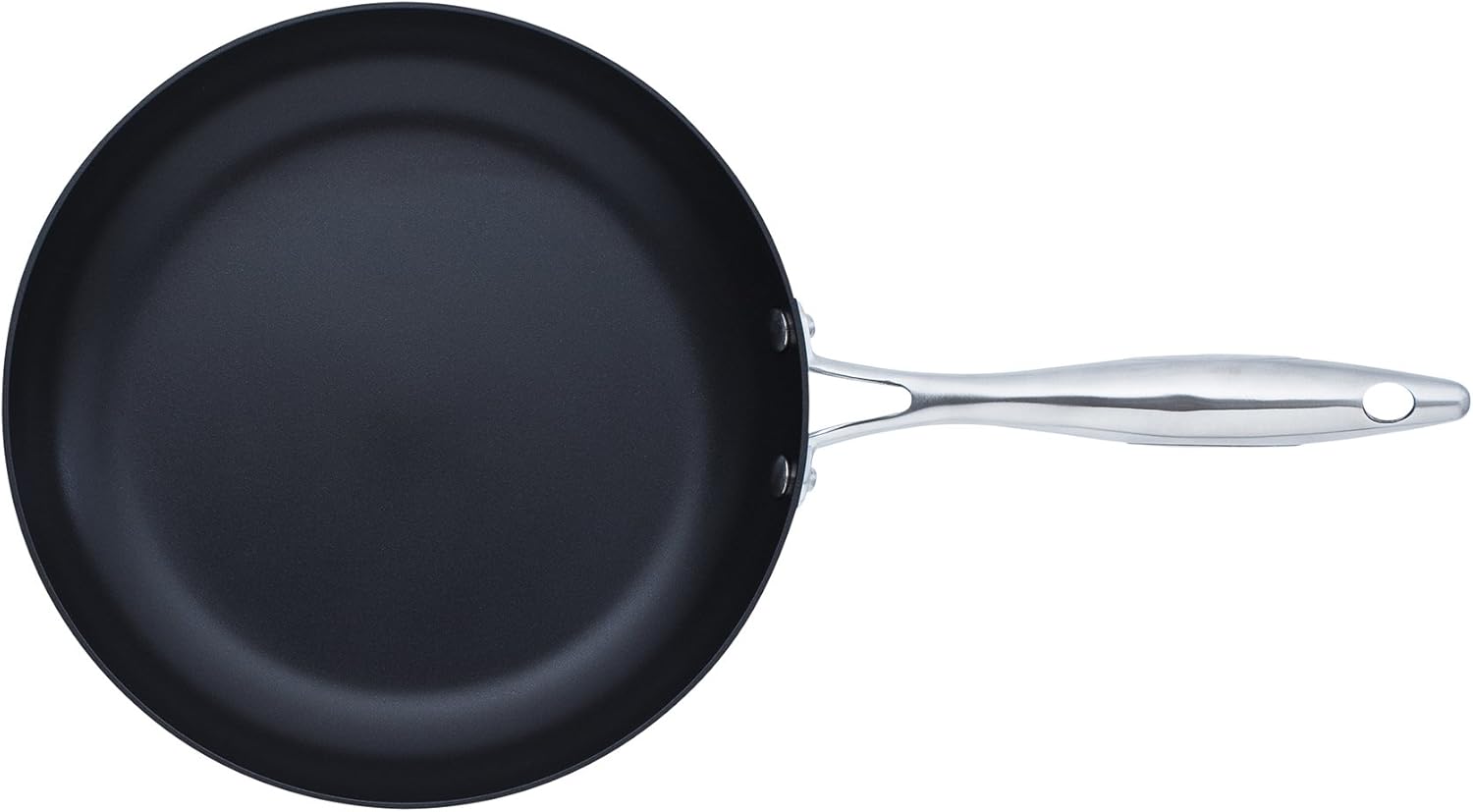
Scanpan is a family-owned Danish company that has made its cookware in Ryomgård, Denmark since 1956. Its non-stick pans are made from recycled aluminum and coated with Scanpan’s own Stratanium non-stick, which is made without PFOA. The CTX line adds a five-layer stainless steel and aluminum body, so it works on induction cooktops, and it’s oven safe to 500°F.
The CTX fry pans have more than 1,000 ratings on Amazon, with an average of 4.6 stars.
One caution: not everything with the Scanpan name is made in Denmark. Its non-stick lines (CTX, HaptIQ and Classic) are, but some of its other products, like knives and kitchen tools, are made in China. Check the listing or the box before you buy anything outside of the non-stick lines.
7. Made In Procoat Nonstick 3-Piece Frying Pan – Non-Stick Runner-Up
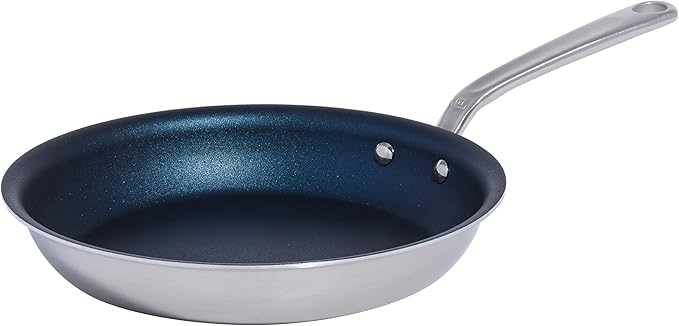
If you absolutely need non-stick, check out Made In. Their cookware is used in many top-rated three-Michelin-star restaurants such as Alinea in Chicago and Le Bernardin in New York.
Made In has an interesting history. The founders had a 100-year history in kitchen supply, and decided to partner with family-owned manufacturers in the US, France, and Italy to build only the best cookware.
While all their pieces are exceptional quality, to me their non-stick pan is–no pun intended–what sticks out. Their ProCoat non-stick pans are made in Italy, coated with PTFE (polytetrafluoroethylene) made without PFOA (perfluorooctanoic acid). If you’re not sure what this means, bottom line is that Made In is going out of its way to make sure its material is safe–in 2016 the Environmental Protection Agency in the US issued an advisory about the dangers of PFOA after testing showed multiple health problems associated with it, from testicular and kidney cancer to liver damage, thyroid disease, and dangers to pregnant women and fetuses. US-based manufacturers agreed to stop using it in making non-stick cookware.
Can you expect the same from manufacturers in China? I think we all know the answer to this. And yet nearly all the non-stick cookware you’ll find in stores is made in China. The few exceptions are on this list: Scanpan, Made In, Zwilling Vitale, Vollrath, Fissler, and GreenPan’s Stanley Tucci line. Even companies like All Clad and Le Creuset who carry non-stick outsource their manufacturing to China.
I highly recommend everything Made In has to offer, but this pan is a must-buy for anyone who wants non-stick. In fact, unlike other manufacturers, they’re very clear that you should hand-wash non-stick cookware–if you’re like me and go through a set every few years, that’s important to remember.
8. Made In CeramiClad Ceramic Non-Stick Pot and Pan Set – Best Ceramic
When I first wrote this blog post in 2023, I couldn’t find a single manufacturer of a ceramic pan not made in China. That made me sad, because ceramic pans are infinitely better than non-stick pans with Teflon or other fluoropolymers. PTFEs were once considered miracle chemicals for making cookware—we all used them in the last few decades, probably a lot longer than we should have. It’s only now that we’re starting to see the extent of the damage they do, both to ourselves when we ingest them, and to the environment on both sides—when they’re made and when they’re discarded.
Ceramics, on the other hand, are simply…sand. Not a big deal to you or your family’s health if a little of it gets into your system, and much, much friendlier to the environment.
But all I could find were manufacturers running to China to get these made. Once again, greedy American corporations were allowing China to monopolize yet another manufacturing sector and supply chain.
I was thrilled recently to find this Made In Ceramic Pot and Pan set, (currently made in Italy; the first version was assembled in Wisconsin) as well as the Fissler below (made in Germany).
Made In’s 12″ ceramic pan earns my pick for best ceramic pan. Built with a 5-ply stainless body and a PFAS/PTFE-free ceramic coating, it combines All Clad-like heat control with safe, eco-friendly nonstick. It’s induction-ready, oven-safe to 550°F, and finished with a gorgeous antique brass handle.
People note its slick nonstick surface, easy cleanup, and sturdy yet balanced feel—all reasons it stands out from typical ceramic pans from China.
9. Fissler Ceratal Classic Ceramic – Ceramic runner-up
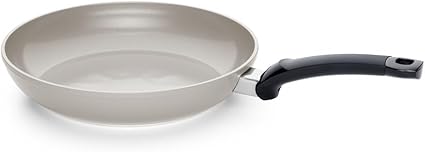
Fissler launched their Ceratal® line in 2022, but only started gaining wider attention more recently. These pans use a water-based, PFAS/PTFE-free ceramic coating, paired with Fissler’s signature CookStar® base for even heating and durability. They’re made in Germany.
Early reviews are positive: people like the eco-friendly materials, easy cleaning, and reliable non-stick performance, with many noting they feel sturdier and longer-lasting than typical ceramic options. If you’re looking for a healthier alternative to traditional non-stick, Fissler’s ceramic pans are definitely worth a look.
10. Stanley Tucci Ceramic Nonstick
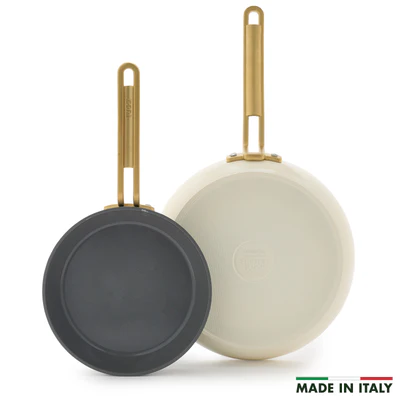
Greenpan, of course, was one of the brands that made a name for themselves with ceramic coated cookware—and because they had everything made in China, they helped China dominate the supply chain.
I am happy to see them course-correcting, even if it’s just a tiny bit. They’re producing a premium line called The Stanley Tucci Collection in Italy. Sets like this two-piece 8″ and 10″ fry pan sets are certainly priced at a premium over Greenpan’s cheaper sets, but reviewers rave about how beautiful and well-made they are.
11. Vollrath Cookware – Restaurant-caliber equipment
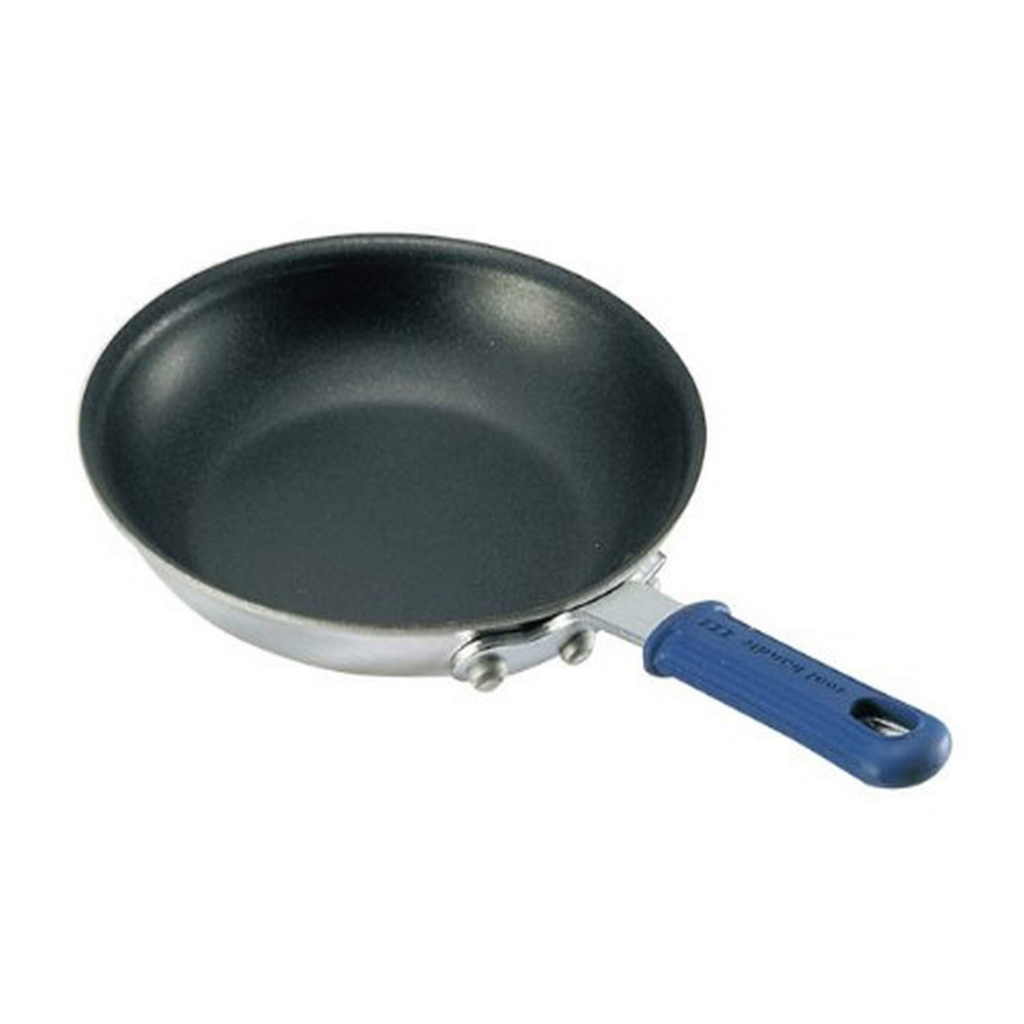
I actually had not heard of Vollrath until recently. But if you’ve ever worked in a restaurant or commercial kitchen, you most certainly have. They began as a metalworking and enamelware manufacturer in the 19th century and gradually transitioned into food service equipment as commercial kitchens became more standardized in the early 1900s.
They’re a huge company that makes everything from buffet and serving equipment to food warmers and heated display systems to tray delivery systems used in hospitals, schools, and correctional facilities. They also make a full set of cookware and kitchen tools, mainly for use in commercial kitchens.
Many of their products are still made in the USA, and they’re known for being reliable and durable.
I was happy to see that they now have a presence on Amazon. Here’s their Amazon Store page that has links to both commercial equipment, as well as what they call “smallwares”—everything from tongs to ladles to frying pans to mixing bowls. Their Wear-Ever fry pans are listed as made in the USA on Vollrath’s own product pages; for anything else, you can confirm by cross-referencing with their site.
Vollrath doesn’t sell to consumers directly, so most of these listings come from authorized sellers. Here are some of the most popular cookware items.
- 17″ x 14″ cookie sheet (aluminum)
- 18″ x 13″ cookie pan (aluminum)
- 10″ non-stick fry pan (aluminum, with CeramiGuard II surface)
- 12″ non-stick fry pan (aluminum, with CeramiGuard II surface)
- 8″ non-stick fry pan (aluminum, with CeramiGuard II surface)
What I like about these is that they don’t waste our time with slick marketing, and you can tell from the reviews that they’re genuine, unlike China-made kitchenware with thousands and thousands of reviews that came as a result of heavy marketing. They’re built to last in environments where they’re constantly used and re-used.
12. Hestan NanoBond 5-Piece Titanium Essential Cookware Set

If you’re a serious chef, or want to impress one, consider Titanium cookware from Hestan. These don’t come cheap, but they’re the most durable cookware on the market. The titanium surface is 400% harder than stainless steel, and completely toxin-free and non-porous. Like all Hestan cookware, it’s made in Hestan’s own factories in Italy.
It heats up to 1050 degrees Fahrenheit and will withstand metal utensils, dishwashers, and even being on the grill. It’s not for everyone, but if you can afford it you’ll have a set of cookware that’ll last you for life, and beyond.
13. 360 Cookware Stainless Steel Sets – A Solid Made in USA Brand

You may recognize the 360 Cookware name from my article on slow cookers. They’re literally the only company I can find anymore making slow cookers outside of China.
They also have an impressive selection of cookware, made of surgical grade stainless steel (meaning their manufacturing material and processes are the cleanest you’ll find anywhere). What’s nice about 360 Cookware is not just the quality of their cookware, but the fact that they’ve kept making their cookware in West Bend, Wisconsin rather than sending it to China. They’re also upfront about sourcing: by their own count, more than 85 percent of their production and components come from the USA. Check out their pots and pans, their bakeware, and their flatware.
14. Zwilling Vitale Cookware

Consumer Reports named this as one of the best cookware lines. It almost escaped my notice because so many other Zwilling lines are made in China, but Zwilling lists Italy as the country of origin for the entire Vitale line.
The pans have a thick aluminum body with Zwilling’s Granitium non-stick coating, which is reinforced with ceramic particles and safe to use with metal utensils. They’re oven safe to 500°F and dishwasher safe, but they won’t work on an induction cooktop. The 10-piece set is rated 4.8 out of 5 on Zwilling’s site.
15. Demeyere Industry 5 Stainless Steel – Premium Stainless Steel

One of our readers pointed out Demeyere in the comments, and it deserves a spot here. Demeyere is a Belgian brand that’s now owned by Zwilling, and along with the Vitale line it’s one of the Zwilling brands that has kept its manufacturing out of China. Zwilling lists Belgium as the country of origin for Demeyere’s Industry 5 and Atlantis lines.
Industry 5 is five-ply, fully clad stainless steel with a thick aluminum core. The handles are welded on, so there are no rivets on the inside of the pan to clean around, and Demeyere’s Silvinox finish keeps the steel looking new and resists fingerprints. It’s thicker and heavier than All-Clad’s D5, and priced like it. If you want the very top of the line, Demeyere’s seven-ply Atlantis series is also made in Belgium.
16. Mauviel M’Heritage Copper Cookware – Best Copper

Another reader suggestion. Mauviel has been making copper cookware since 1830 in Villedieu-les-Poêles, a town in Normandy known as “the city of copper,” and it still makes it there today.
The M’Heritage line has a copper exterior (90%) bonded to a thin stainless steel interior (10%), so you get copper’s fast, even heating without ever having to re-tin the lining. The 150 series is 1.5mm thick, which is plenty for most home cooks; the 200 series is 2mm and aimed at professionals.
Copper isn’t for everyone. It isn’t dishwasher safe, it won’t work on an induction cooktop without an adapter disc, and it needs polishing if you want it to stay shiny. But if you want the most responsive cookware you can buy, this is it. Mauviel also makes carbon steel (M’Steel) and stainless steel lines in France.
Conclusion
Do you know of other cookware not made in China worthy of mention here? Let us know in the comments!

In Europe there are still quite some pot and pans manufacturers, for instance these:
– Fiskars, most of the pans are made in Finland
– Demeyere, most of the pans are made in Belgium
– Tefal, most of the pans are made in France
– WMF, several pans are made in Germany
– Woll, the aluminium pans are made in Germany, stainless are made in China
– Ballarini, made in Italy
– Lagostina, made in Italy
– Scanpan, the aluminium pans are made in Germany, stainless are made in China
– Valira, made in Spain
I own quite a few of the above mentioned pots and pans, all very good quality.
Some Scanpan stainless steel pots and pans are made in Denmark, not Germany.
People underestimate the importance of a good pan, especially if it is a pan with Teflon.
The Teflon of Chinese pans can be toxic when heated, you don’t want that on your food!
Invest in good pans, don’t buy Chinese pans.
Any pan with teflon is not good for you. Chinese made or not! Think forever chemicals.
I’d like to add another three Spanish brands to this list that are still holding out and producing in the EU:
Magefesa, BRA and Lacor
– Magefesa mostly make non-stick cookware that is reasonably priced (lower-mid range). Cheap and cheerful!
– BRA make lovely, mid-range pots and pans and their stainless steel collection is sturdy and built to last (from firsthand experience).
Check before buying if the specific model is “made in Spain” or “assembled in Spain”, as a couple of years ago they shifted production to China, but it seems that they might be shifting back due to Covid-related logistics
– Lacor is a Spanish brand that actually still manufactures in the north of Spain.
They are not well know outside of professional circles as they mainly cater to chefs, etc.
When it comes to cookware, everything except their entry-line pans are made in Spain, with outstanding quality!
Thank you so much for your comments, Abe! They are especially helpful because most of my information comes from US sources, but I know there are a lot of local manufacturers in the EU that continue to take pride in their craftsmanship and their local communities. We must continue to support them.
I hope if an American retailer is reading this, they take note that a wave is coming where a combination of China’s insolence and their record of poor quality will result in a big backlash. So they’d be best to diversify their supply chain, especially to freedom-loving countries.
I have about 10 Lacor stainless steel pots made in Spain. Beautifully made. Some I bought here in Israel, and some I bought from amazon.es.
Really glad for this website; and am especially grateful for the comment listing the European brands that are not made in China, in addition to those made in the USA. There are good quality European brands!!
Meyer pots and pans are made in Prince Edward Island, Canada. I’m really happy with my set.
Their parent company is in Hong Kong.
Hong Kong is/was not China. The parent company of Meyer was founded in Hong Kong in the 1950’s when Hong Kong was a British colony.
Hong Kong was not China.
Hong Kong is China.
Fissler made in germany?
Not all Fissler. The cheaper ones are made in China when I last checked a few years back in both Australia and Taiwan.
Great reviewing on choosing the cookware. It’s always terrible work. Your post reminds me of the best cookware to keep in your collection.
Thanks.
NB –
Le Creuset non-stock cookware IS made in China
I’ve just emailed Procook to double-check where their products are made – all their goods are made in China.
Also the entire Essteele range is made in Italy. Works a treat, better than Tefal in my opinion.
It’s great the pans are not made in China. But more importantly, where do the materials originate from? If the steel and the other materials comes from China, it doesn’t matter where it is made. The quality and origin of the materials are more important than just where it’s made.
That’s a great question, Taime. I wish all manufacturers would be as transparent as 360 Cookware with this information. Here’s an example:
https://www.360cookware.com/pages/where-is-360-cookware-made
While the can’t avoid going to China for certain parts, it looks like the cooking surfaces are all from the USA or South Korea, with things like handles being made in China. I appreciate honesty like this.
Other companies are less transparent.
https://www.lecreuset.com/about-le-creuset/about-le-creuset.html
While they use general phrases like “premium materials” they stop short of going into detail. Worse, if you call the company to ask, it’s likely that their employees won’t know either, as the only legal requirement is to list out the last country where the most transformation took place; there is no law that requires companies to list out where they source all their raw materials from. We saw the same challenge with vitamins and dog food–most of the cat and dog food that caused poisoning in 2007 was marked as “made in USA” or “made in Canada” but sourced its protein from China.
I believe that in the long run the most successful companies will be ones like 360 Cookware which trusts its customers to be able to handle knowledge. In the meantime, the best we can do is keep sharing information as we find it, and keep rewarding companies who show transparency and respect to their customers.
Seconded that Paderno is made in PEI in Canada. Our 13-piece set is stamped with Made in Canada on the bottom. Happy to report that our ten year old set is showing essentially no signs of wear. Very even heat control. No complaints! We are avid home cooks and the quality holds up well.
https://www.paderno.com/collections/cookware/made-in-canada
Of note: Their cooking utensils and everything beyond the pots is made elsewhere, and likely China. Similar system to Le Creuset where only their enamelware is made in France.
I just purchased HexClad product, when I pulled it out of the box the life time warranty had no address, no company info, just a phone number. the think that caught my eye in big bold letters on the box P.R.C.
The Chinese Communist Party (CCP) is the founding and ruling political party of modern China, officially known as the People’s Republic of China. WOW!!!!
Frieling makes something similar made in France. So far we are finding it works as well as hexclad. https://direct.frieling.com/CeramicQR_by_Black_Cube_Quick_Release_9_5_Fry_pan_p/bcc2124.htm
Does anyone know where Stellar pans are manufactured?
Stellar is made in Bristol, England
This is an easy one. There are three famous brands: Mauviel, De Buyer and Bourgat, all made in France. These are extremely good quality.
Unfortunately this seems to be no longer true. I’ve just acquired some Mauviel 1830 through Victoria’s Basement. On the box it says “made in PRC” and distributed by “the cookware company Europe Belgium” On the box I also note their website is http://www.mauviel-care.com, not Mauviel.com
Heritage Steel (https://www.heritagesteel.us/) makes all of their cookware in their factory in Clarksville, Tennessee.
Nordicware has cookware. The Verde line I like a lot, but they are lighter weight. They are induction compatible.
The Basalt line is quite nice, and good quality. However it is not compatible with induction
Your website and information is a real discovery for me and a wonderful source of information about everyday goods as I have been wanting goods not made in China for years now and I find Amazon very bad about not giving the country of manufacture so that I can make an informed choice. Thank you! And please keep it up and continue your good work. I will pass on your website to family and friends. I am so sick and tired of everything made in China. I recently installed solar panels, but only if they are not made in China and the contractor was able to source some that are made in Singapore. It just shows if you look, you find.
While All-Clad cookware you list is “Bonded, Engineered, & Assembled in USA,” it does say with global components, which I believe applies to the models you list, D3 and D5. I believe lids and handles are sourced from China.