Updated 1/28/26 – Added European and Japanese models, with information on the use of step-up transformers for European models. Added more commentary on the state of electric kettles today.
What is an “Electric Kettle”?
There are a lot of names for “portable appliance that can heat water and dispense it for use with tea, coffee, hot chocolate, instant noodles, or hot water”. In some cases people are looking for an “electric water boiler or thermo pot”, where water is stored in a pot and you can push a button to dispense. In other cases people are looking for an “electric kettle”, that looks a lot like a regular kettle, but which can be heated on an electric base.
Whatever you call it, it’s becoming harder and harder to find one that’s not made in China. Cutting to the chase, you can find hot water heaters, but you cannot find traditional electric kettles that your pour.
By the way, if you’re looking for a non-electric kettle (i.e., a traditional tea kettle), see our earlier reviews of the best tea kettles not made in China.


Can I find anything not made in China?
If you Google “electric kettle not made in China”, you’ll see sites that reference brands like Saki, Mueller, Hamilton Beach, and even Amazon Basics. Don’t be fooled–these are all made in China. The only brand I was able to find that still sells non-China products to the US market is Zojirushi, and even then you need to look for certain models.
Even more laughable, let’s look at Google AI’s “recommendations”:
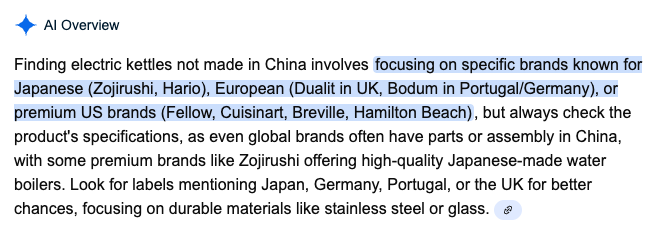
Hario V60 – Made in China
Bodum Bistro – Made in China
Fellow Stagg – Made in China
Cuisinart PerfecTemp – Made in China
Breville IQ – Made in China
Hamilton Beach – Made in China
Dualit – Most models made in China, except for one notable one which I mention below.
In fairness to AI, all they have to go by is what’s written online, and the seven manufacturers listed here, as well as the retailers who sell their products will go COMPLETELY out of their way to avoid telling you who makes their products. You’ll even see phrases like “Designed in Australia”.
Rest assured, you can always come back to this site to find the truth. I will never say anything is not made in China unless I see proof that it is not made in China. Period.
What about Dualit?
As you probably know from my post about toasters not made in China, Dualit is a standout because while many of their parts are made in China and elsewhere, they insist on doing the final production in the UK.
This is a case where even I was fooled, and I’ve been doing this for a long time. A saw “made in the UK” on a few sites and got excited, only after a LOT of digging to find that no, Dualit does NOT make its kettles in the UK. There is an interesting initiative called the British Domestic Appliance Company that seeks to produce kettles in the UK again, but sadly, while they said they’d start production in 2024, they are still struggling to find investors—a sad sign of how complacent citizens of the UK have become. And even if they do end up shipping products, they won’t be coming to the US anytime soon, as the UK is on a different electrical system.
So the dream of finding a decent pouring-type kettle in the US is basically dead. But thankfully, there are options for hot water boilers. Support them by buying them before China puts THEM out of business too.
Best Electric Kettles Not Made in China
1. Zojurishi Hybrid Water Boiler and Warmer – CV-JAC40 and CV-JAC50
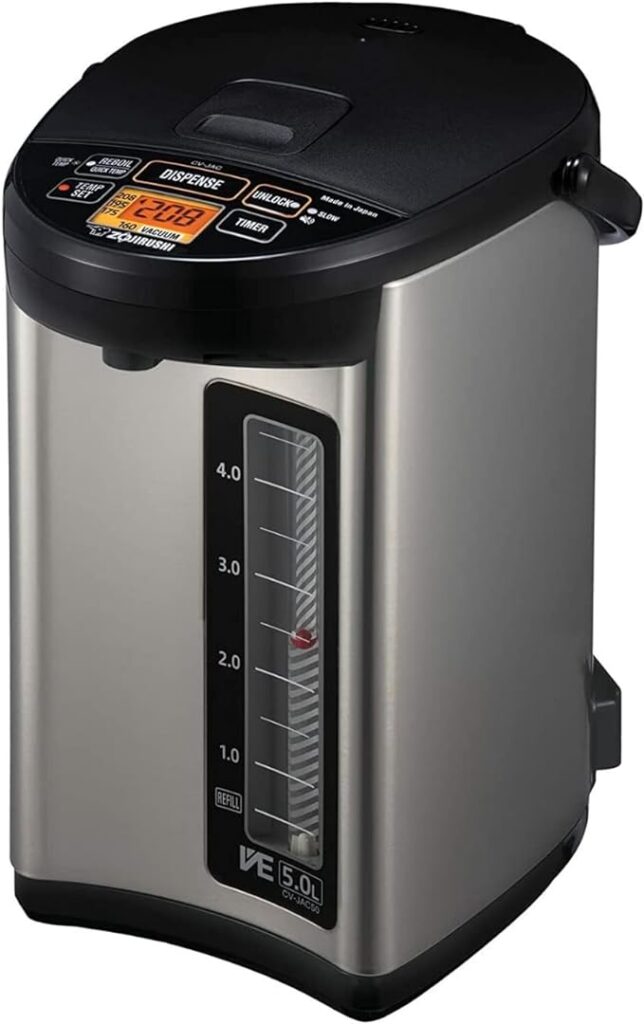
One thing I love about the Zojirushi Web site is that there’s a filter that shows you very clearly whether a certain product is made in Japan with none of the trickery that sites like Amazon use to try to obfuscate China-made from Japan-made products.
The VE (vacuum electric) Hybrid Water Boiler and Warmer comes in 4-liter (4.2 Quarts) and 5.0 Liter (5.2 Quarts) sizes respectively. It boils water and then maintains it at precise temperatures of 160, 175, 195, and 208 degrees Fahrenheit. If you’re wondering the significance of these temperatures, you’re probably someone who, like me, has always thought that hot water is hot water.
160°F is the optimal temperature for brewing “delicate” teas like white tea. 175°F is ideal for brewing green tea. 185°F is best for oolong tea, and 208°F (just off boiling) is ideal for black tea, herbal tea, coffee, instant noodles, instant oatmeal, and even blanching vegetables. If you’re chuckling at this premise, like I said I was once like you, but I became a believer the moment I tasted green tea at 175° vs. 212°.
If you’ve owned a rice cooker or other appliance from Zojirushi, you’ll know that the Japanese put the same engineering prowess into their appliances as they do their cars. The vacuum insulation technology (the same as used in high end travel mugs) and micro computerized (“Micom”) temperature control keep water at the precise temperature (and an easy-to-read LCD panel and controls), and a “quick temp” mode heats the water without it coming to a boil, if that’s important to you. There’s a timer function that can shut off after 6-10 hours. The insulation is stainless steel that you know has never seen the inside of a Chinese factory. You can view through a clear window how much water there is.
Lots of people may scoff at the thought of paying $200 for a pot that boils water, but if you drink tea or pour-over / French press coffee every day, you’ll wonder how you lived without it.
There’s also a slightly more affordable model, also made in Japan, called the CV-DCC40 (4-liter) and CV-DCC50 (5-liter) that’s similarly vacuum sealed, but is slightly slower to heat (840W vs 930W)
2. Zojirushi Micom Water Boiler & Warmer CD-NAC40/50
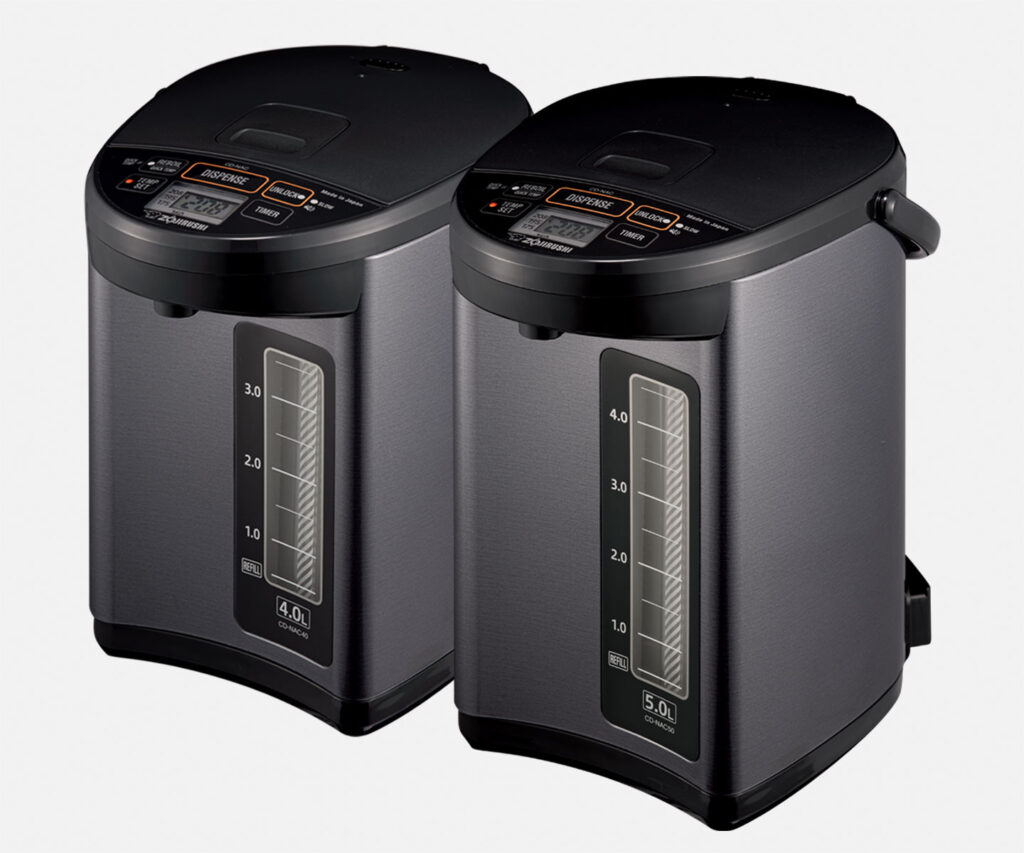
This is essentially the same product as above, except that it lacks the vacuum seal for heating efficiency, and it comes in a stylish black color. It does have the same Micom technology for precise temperature control.
3. Tiger Microcomputer Controlled Water Boilers PDU-A30U/40U/50U
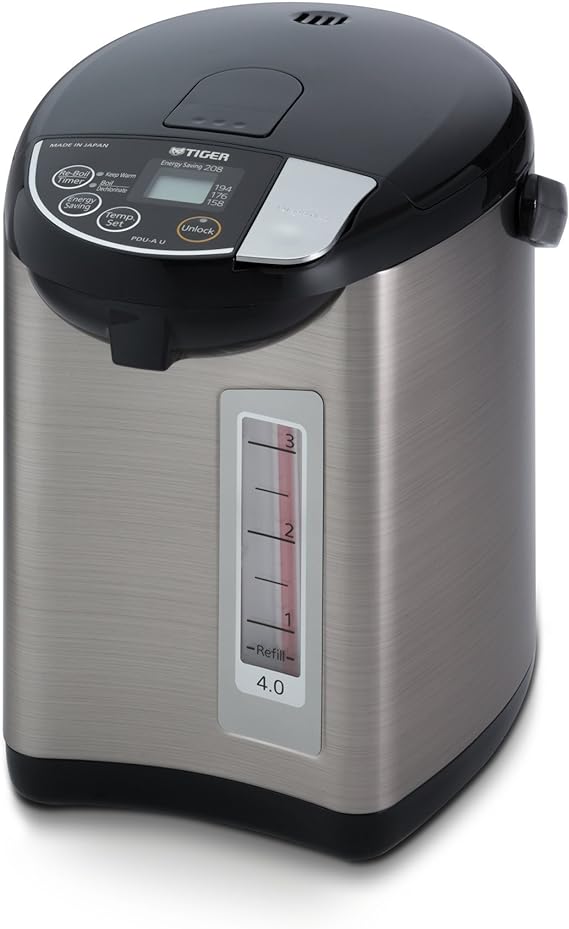
h/t to W for posting this one in the comments. It looks like it’s made in Japan by Tiger, one of the big Japanese brands. The reviews on this one are pretty stellar; users love the fact that they’re dependable and won’t break even after daily use; they use it for coffee, tea, instant noodles, and just about every other application that needs hot water. It comes in 3, 4, and 5 liter sizes (you can toggle between the options in the area on the Amazon page under the price.
I notice that as of this writing, the 4 and 5 liter sizes are available from Amazon, while the 3 liter size is only available from a third-party seller. To avoid counterfeiting, grey market, and used items packaged as new, I’d suggest buying only from Amazon.com as the seller, unless you do your research on the third party seller.
Plug-in Kettles in Europe and Japan
I know a lot of folks on this page are looking for plug-in kettles, i.e., kettles that look and pour like traditional kettles but aren’t made in China.
Here are some options from Europe and Japan. It’s actually not the most practical to get step-up and step-down transformers for these; with toasters, it could make sense since toasters don’t draw a lot of wattage. Kettles, of course, can use a tremendous amount, so with step-down transformers you need to buy high-end ones that support the wattage, and with European models you basically need to re-wire your house to support 240V outlets that are rated at least 3000W, plus a circuit that can handle the load,
So this is mainly reference for our friends in Europe and Japan—and hopes that some of these companies will realize that they can make a fortune by being the first to build a model for the US market.
European options (240V)
5. Ritter Kettle cavita
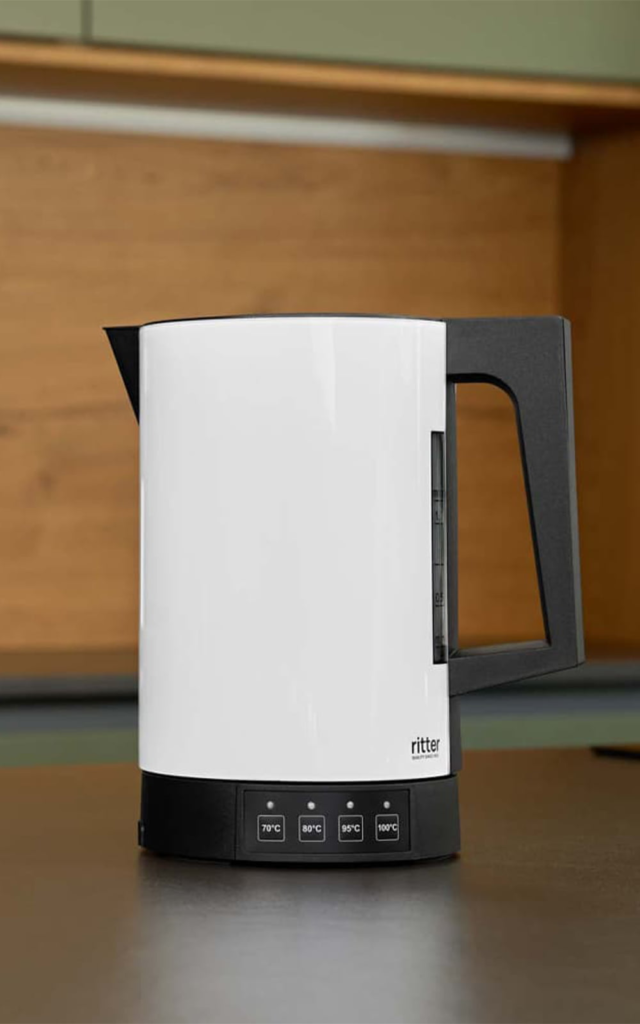
Several of our friends in Europe wrote in the comments about Ritterwerk, who makes excellent electric kettles in Germany.
It’s won design awards and the function matches the form, with four temperature settings, a safety lid, and an outer housing made of high quality acrylic glass. It’s built to last and to be repaired, not tossed away in a landfill.
Alas, out of reach for our US audience, but by many accounts the go-to product for European households given the German engineering and standout design.
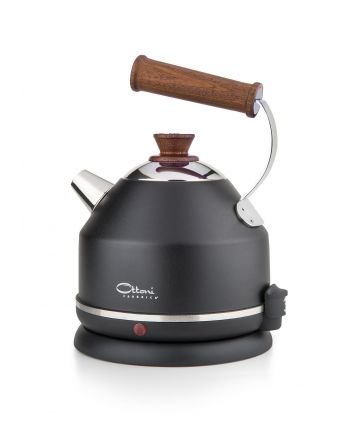
6. Otto Fabbrica
Otto Fabbrica is another iconic European brand that’s kept its production in Italy, and that includes its electric kettles. If you’re lucky to be shopping for these in Euope, these are a great option.
Remarkably, its certified components are sourced exclusively from Europe and produced in their family-run company on Lake Maggiore, Italy.
These two models are examples of brands that still take pride in their brand and workmanship, as opposed to American companies (who pioneered the industry) who seek profit over any other consideration.
Japanese options (110V)
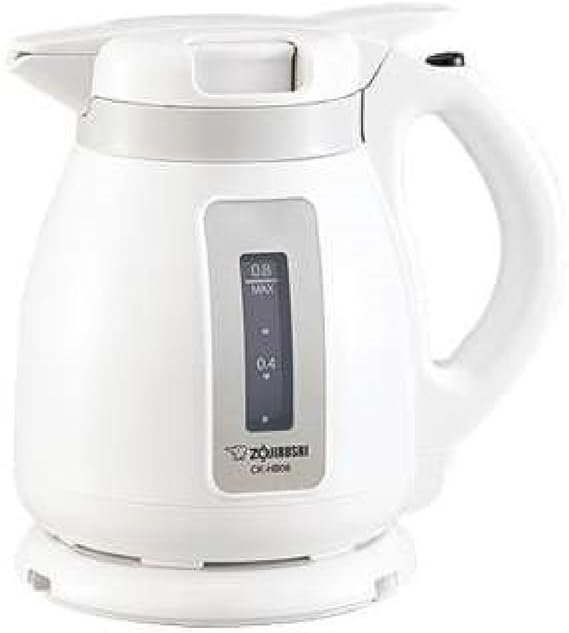
7. Zojirushi CK-HB08-WA
One of the sellers reports that this model is made in Indonesia. I don’t think I need to say more about the consistency of Zojiushi’s quality, and I’m happy to see that unlike their competitor Tiger they seem to be making an effort to avoid China (but again, be careful, as a lot of cheaper Zojirushi SKUs are made in China). The reviews are pretty stellar, including one from someone who said they saw these in hotel rooms in Japan (which is usually a great indicator of durability). Again, remember that this was designed for 100V, so I wouldn’t plug it into a 120V outlet without an appropriate transformer that can handle the power.

8. Tiger WAKUKO Kettle (A081-H)
This one has a lot of great reviews. Reviewers in Japan love how it boils quickly and is easy to use and pour. Most Tiger electric kettles (even ones they sell in Japan) look like they’re made in China, but one Amazon reviewer reported back in 2018 that this one was made in Vietnam. You should of course reach out to the seller to verify before they ship it. If the seller does ship you a different model made in China, ship it back within 30 days at their cost. Once again, remember that this is designed for Japan voltage.
Conclusion
It really saddens me to watch the death of an entire industry before my eyes. Yes, American and European consumers snap up cheap electronics and save a few dollars. Yes, American and European corporate executives see whirlwind profits and their net worths skyrocket.
- A portion of every cent you pay goes to fund China’s military and surveillance state and their oppression of speech and religion.
- American and European workers are put out of work, leading to more burden on the social welfare state (and jobs that require manual labor are the only ones that AI won’t be displacing).
- Once China monopolizes the industry, it also monopolizes the supply chain. That means it can price kettles however it likes. We may be saving $3 on a kettle today, but our children will be paying $30 more for the same kettle.
- Here’s an impact that most people don’t see. When production goes to China, innovation ceases. You’ve seen it for yourself. Have you seen improvements in the designs of kettles, toasters, air fryers, or any other appliance that China has taken over? Back when production and design happened in the US, there was incentive to “build a better mousetrap”. But now, the game is to produce as many mousetraps as possible using a 100 year old design and force it down the throats of consumers, who happily eat them up.
My best advice? Buy a water boiler from Japan if you need a kettle, or a traditional non-electric kettle (plenty of options still exist here). But don’t feed the beast.
Do you know of other electric kettles or hot water dispensers not made in China worthy of mention here? Let us know in the comments!
- Tags:
- electric kettles
- kitchen

https://www.graef.de/en/info/electric-kettle/
and
https://www.ritterwerk.de/en/wasserkocher-fontana-5-schwarz
are both made in Germany
The Graef appears to be made in China. German company of course. The Ritter Fontana is made in Germany but at £200+ a bit beyond my budget.
I’ve got the Ritterwerk Fontana now, and it comes with four switches for different temperatures and a safety lock, and has a bauhaus-inspired look. Compared to Chinese stuff, this is luxury!
Ottoni Fabbrica Italian producer of keetles and electric keetles.
https://ottonifabbrica.com/en/
Electric keetles are Made in Italy with all parts sourced from Europe. Heating element is German made, the metal part Italian made.
Finding them here in US is not easy.
Did you ever find an option? I’ve been searching up and down and it seems really impossible. I’d even settle for something that would require a converter on the plug if they’d ship to the US. 🙁
So far the only thing I could find was https://www.amazon.com/stores/Viant%C3%A9/page/D139485F-89B8-4CB8-A254-6B1EDCB7426C?ref_=ast_bln maybe they don’t outsource to China but unsure….another site said they weren’t made in China but I’ve been unable to really verify.
Unfortunately Vianté electric kettles are made in China 🙁
But they don’t ship to USA
What is the best plug option to get for the United States? I assume that I will need a converter.
Thanks for the comment Miwa. I updated the post with more details on plug-in kettles. Unfortunately the news isn’t great, but I tried to be as complete and accurate as possible.
My conclusion is that the best thing all of us can do is to contact Zojirushi and Tiger directly and ask that they bring their models to the US and US voltage. The reason they don’t isn’t because they’re being “mean” but because it’s simply not economically viable for them. If enough of us contact them, hopefully they’ll get the message.
More importantly, tell your friends not to buy made in China models from even the “big brands”. Every time someone buys from them, it’s validating their decision to support China.
I went on the Kitterwork website to view their kettles. Although the kettles are listed I could not find a way to purchase or add to shopping cart. My guess is it’s not available in the US. Same with the Italian make: not made with US plug.
I really like this Tiger model I purchased. It is available in North America. Made in Japan
Tiger PDU-A30U
https://tiger-corporation-us.com/product/pdu-a30u-3-0l-pdu-a40u-4-0l-pdu-a50u-5-0l/
Thanks so much W! I added this model to the “best of” list! 🙂
that model has a plastic inside?
Yes, that is my concern. Heated plastic is not healthy.
This model has a material other than stainless steel for the inside.
Could we buy electric hot water dispenser ( similar to the Zojirushi) with 220v – using in uk? Almost all the products are 100v. If it shows 220v, it didn’t show in this review- that’s why I am wondering if it is mic!
Looking forward to hearing more info & reply!
Hi Leung,
You’re in luck. It looks like Zojirushi produces 240V versions of these and similar models out of Japan.
https://www.amazon.co.uk/Zojirushi-Hybrid-Electric-Dispensing-CV-DSQ40/dp/B01M8J5U3F/
For those of you going to Japan and thinking about picking up a kettle (or rice cooker or… any of the other great products Tiger/Zojirushi produce) on the way home: the duty free zone at the airport may be your friend. Contrary to the domestic electronics shops those at the airport usually carry those models that support 230V.
I just found the GreenPan Co. Their Stanley Tucci collection products, including electric kettles, are made in Italy. The kettle is currently on sale for Earth Day for $34.95. Which is kind of unbelievable. I’ll see how long it lasts!